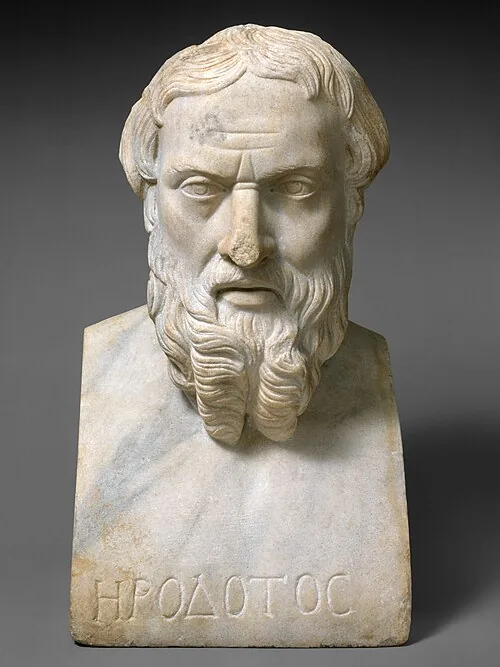
Histories 4.169. Herodotus places silphium in the country of the Gilligamae, from Platea to the Syrtis.
Original text
Ancient GreekΤούτων δὲ ἔχονται Γιλιγάμαι, νεμόμενοι τὸ πρὸς ἑσπέρην χώρην μέχρι Ἀφροδισιάδος νήσου. ἐν δὲ τῷ μεταξὺ τούτου χώρῳ ἥ τε Πλατέα νῆσος ἐπικέεται, τὴν ἔκτισαν οἱ Κυρηναῖοι, καὶ ἐν τῇ ἠπείρῳ Μενέλαος λιμήν ἐστι καὶ Ἄζιρις, τὴν οἱ Κυρηναῖοι οἴκεον, καὶ τὸ σίλφιον ἄρχεται ἀπὸ τούτου·
παρήκει δὲ ἀπὸ Πλατέην νήσου μέχρι τοῦ στόματος τῆς Σύρτιος τὸ σίλφιον, νόμοισι δὲ χρέωνται οὗτοι παραπλησίοισι τοῖσι ἑτέροισι.
English
New working translation for this atlasNext to these are the Gilligamae, who occupy the country westward as far as the island of Aphrodisias. In the intervening country lies the island of Platea, which the Cyreneans settled. On the mainland are Menelaus's harbor and Aziris, where the Cyreneans lived; silphium begins there.1
Silphium extends from the island of Platea as far as the mouth of the Syrtis.2 The customs of these people resemble those of the others.
Further reading
- 01Suzanne Amigues, “Le silphium — État de la question,” Journal des Savants (2004), 191–226. ↗
A close study of ancient evidence for the plant's range, identification, and later testimony. - 02Lisa Briggs and Jens Jakobsson, “Searching for Silphium: An Updated Review,” Heritage 5 (2022), 936–955. ↗
Surveys the sources, material evidence, trade, and proposed botanical identifications.